Recurring bills and the bills calendar
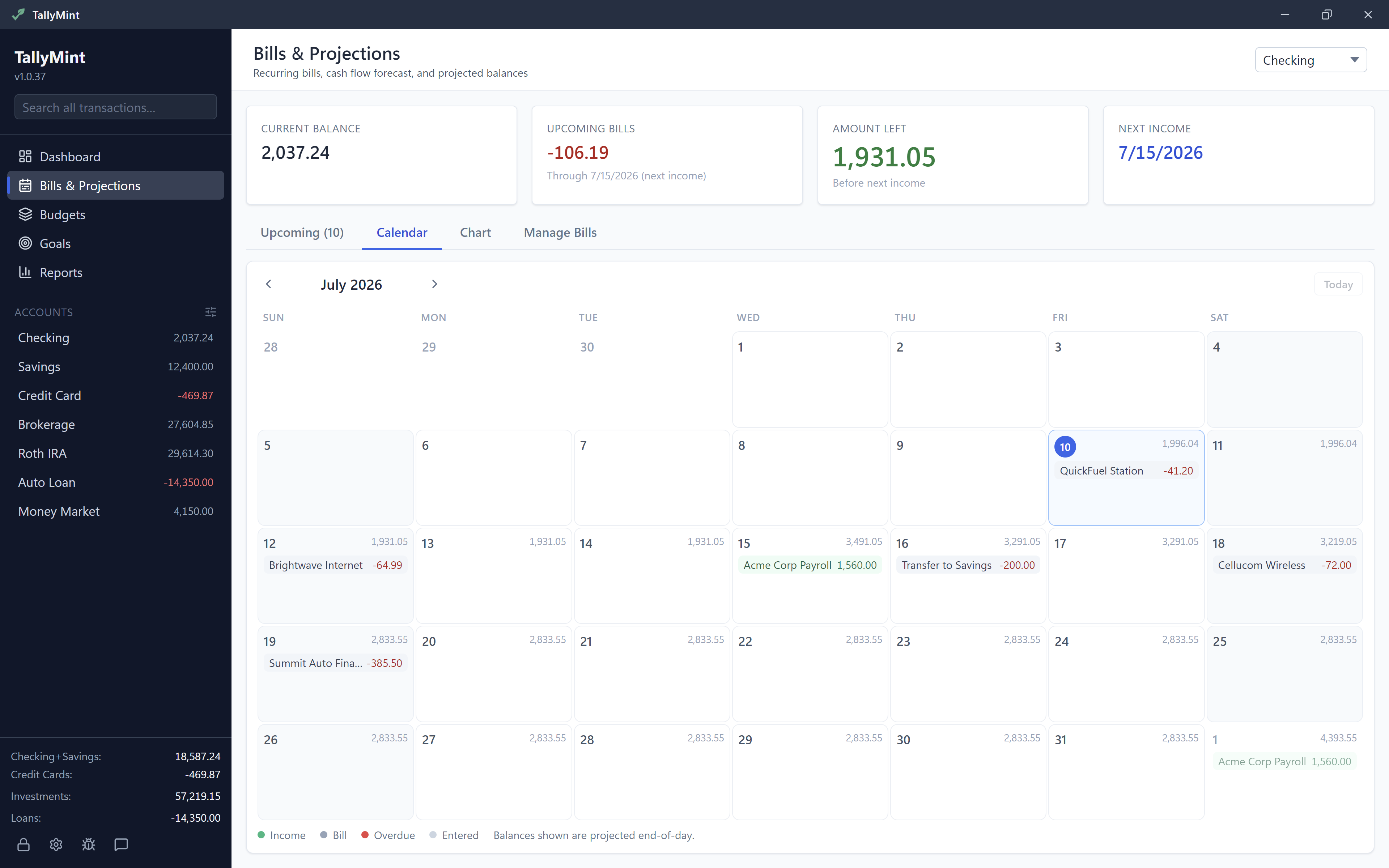
Recurring bills are the memory of your ledger: rent, utilities, insurance, subscriptions, and paychecks, each entered once with a schedule. They fill the monthly calendar, drive the balance forecast, and, if you let them, enter themselves in the register on their due dates or a set number of days earlier. Everything lives in the Bills & Projections view, which has four tabs: Upcoming, Calendar, Chart, and Manage Bills.
Adding a bill (or a paycheck)
In the Manage Bills tab, add each recurring item with its payee, amount, account, category, and schedule. Frequencies cover real bills: weekly, bi-weekly, twice a month (the 1st and 15th), monthly, quarterly, and yearly, each with an interval you can widen (monthly every 2 months, for instance) and the day of month or weekday under your control. Income works the same way; a paycheck is just a recurring deposit, and entering yours is what makes the forecast worth reading.
Auto-enter, or confirm by hand
Each bill has one decision attached: auto-enter, on or off.
- Auto-enter on (the lightning bolt): the transaction posts to your register by itself, without you clicking anything. Right for fixed, predictable amounts like rent, a mortgage payment, or a streaming subscription.
- Auto-enter off: the bill appears in Upcoming when due and waits for you. Right for variable amounts like a utility bill, where you confirm the real number as you enter it.
How far ahead an auto-entered bill posts
With auto-enter on, each bill also carries a number: Enter this many days early. Leave it at 0, the default, and the bill posts on its due date, which is how auto-enter has always worked. Raise it, up to 90 days, and the bill posts that many days early instead. Set 3 on your mortgage and it lands in the register three days before it is due.
The date on the transaction does not change either way: an early-posted bill still carries its due date, not the day it was posted. A bill due on the 19th that posts on the 17th is dated the 19th. So entering early does not move the money on your forecast, it only puts the row in your register sooner, where you can see it and where your projected balance already accounts for it. Existing bills are unchanged: they sit at 0 until you change them.
Working the Upcoming list
The Upcoming tab is the short answer to "what is due soon": each occurrence with its date, payee, and amount. From here you can enter an item into the register, edit the underlying bill, or skip an occurrence you will not pay this cycle (a paused subscription, a waived fee). One thing to know: skipping removes that occurrence for good, so if you actually paid the bill, enter it rather than skipping it.
You do not have to wait for a bill to be due to enter it. If you paid something early, or you just want it in the register now, enter the future occurrence straight from the list. It posts dated on its due date, not on the day you clicked, so the bill stays where it belongs in your register and in your forecast.
When several are due at once, you can do them together. Every row has a checkbox, with one in the header that selects the whole group, and an Enter selected button that shows how many you have ticked. Tick the bills you want, or select all, and enter them in one go. Before anything is written you get a confirmation naming how many bills and the total amount, and each one posts dated on its own due date. Overdue bills and upcoming bills are two separate groups with their own checkboxes and their own button, so clearing a backlog of overdue items never touches anything that is not due yet.
Anything left unentered past its due date stays in the list flagged as overdue for 30 days, so a week away from the app never costs you a bill. Deal with it inside that window: occurrences older than 30 days drop out of both the list and the forecast.
Choosing which account you are looking at
Bills & Projections has an account picker at the top. Leave it on one account to work that account's bills, or choose All accounts to see every bill you have in one list, whichever account each one pays from. Each row says which account it belongs to, so nothing gets confused. Projected balances are the one thing All accounts leaves out, on the chart and on the calendar alike: a projected balance belongs to a single account, and TallyMint will not invent a combined one rather than tell you the truth. Pick an account when you want the forecast.
The calendar and the forecast
The Calendar tab lays the month out day by day, the fastest way to sanity-check a tight stretch ("three bills land the day before payday"). The Chart tab is the payoff: your projected balance 30, 60, or 90 days out, computed from these same bills and income. The better your bill list, the more trustworthy that line; the forecasting guide covers reading it.
Tips
- Start with the bills that hurt when forgotten: rent or mortgage, insurance, anything on autopay at the bank.
- For variable bills, enter a typical amount; the forecast uses it as the estimate and you confirm the real number each cycle.
- If you use bank sync, entered bills match against the bank's version of the transaction when it arrives, so nothing double-counts.
- Editing a bill changes its future occurrences; what is already in your register stays put. Change the schedule (the day of month, the frequency, or the dates it runs between) and the occurrences you have already entered move with it, so the bill still knows what is paid and what is due next.